Where Does the Pinyin Tone Mark Go in liú and guì?
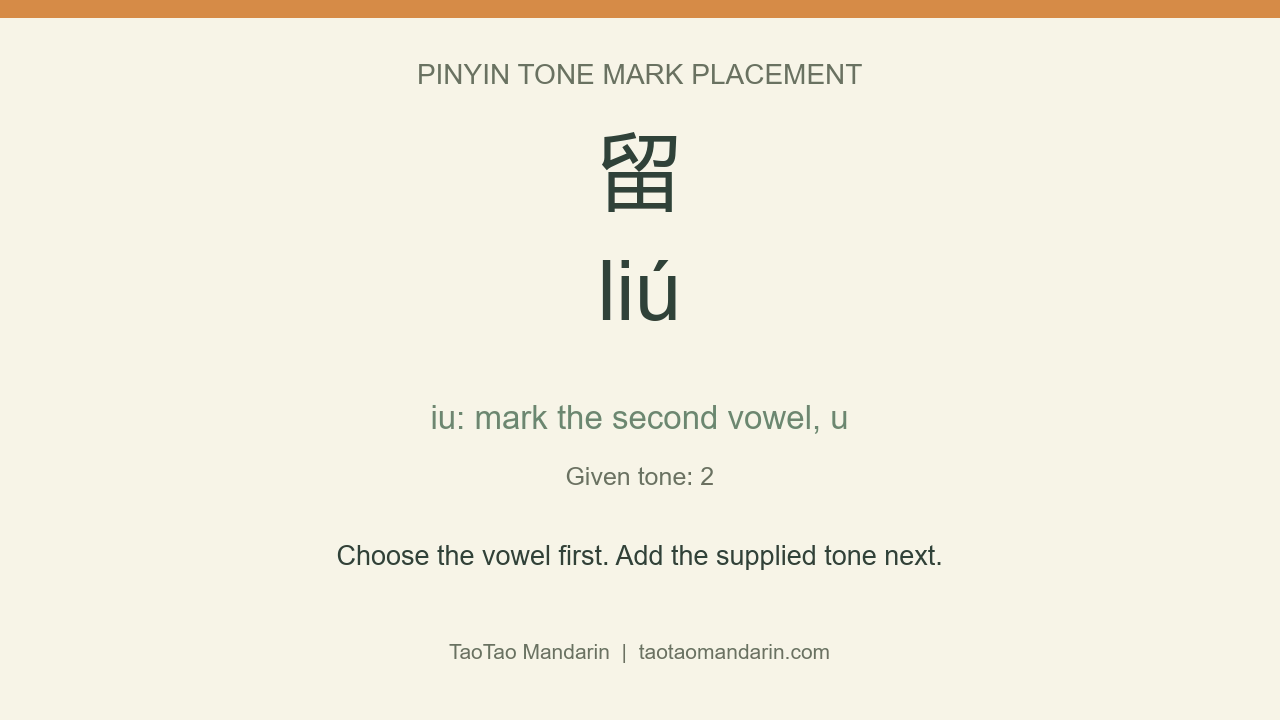
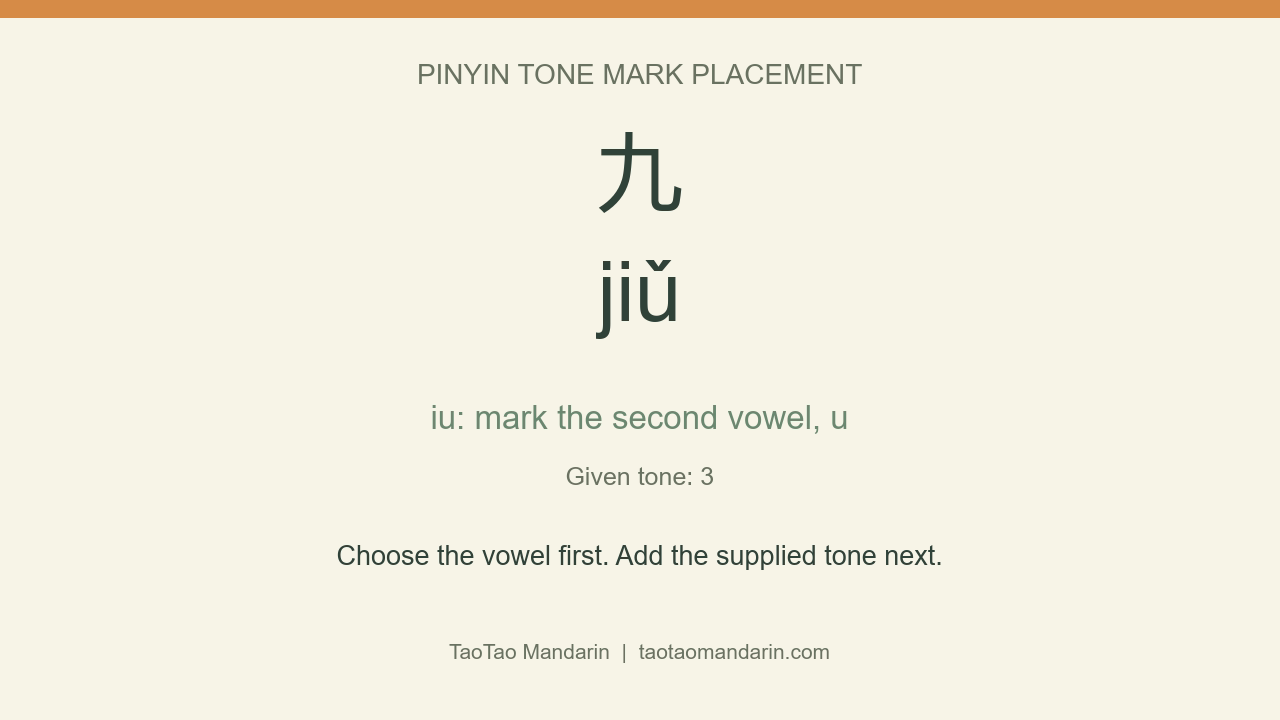
Write liú with the mark on u, and guì with the mark on i. In the written finals iu and ui, the tone mark goes on the second vowel. That also gives jiǔ, with the third-tone mark on u. First identify the word's tone, then place the appropriate symbol on the correct vowel.
A learner can remember the right Chinese tone but still hesitate over which letter takes its mark. Keep those as two separate decisions: “Which tone does this word have?” and “Where does its symbol go in this spelling?” This page practices the second decision while supplying the tones for the examples.
Listen and follow the written forms
The supplied spoken examples are liú, jiǔ, and guì, in that order. The written rule chooses the vowel; the recording is a separate reference for saying the whole syllable.
Watch the illustrated practice
The iu / ui comparison
| Given form | Vowel to mark | Written result |
|---|---|---|
| liu + tone 2 | u, the second vowel in iu | liú |
| jiu + tone 3 | u, the second vowel in iu | jiǔ |
| gui + tone 4 | i, the second vowel in ui | guì |
The Hong Kong Polytechnic University's teaching page states this second-vowel rule for iu and ui. Its spelling section also explains that these written finals abbreviate iou and uei after an initial. You can use the short written forms for the placement task without reconstructing their history on every attempt.
Keep the scope of the shortcut clear: it is for iu and ui. It is not an instruction to put every pinyin tone mark on the last vowel. In jiāo, for example, the mark goes on a.
A choose-then-mark practice routine
Choose the letter before drawing a tone
Write three unmarked prompts on separate cards: liu, gui, and jiu. Cover the completed examples above. Circle the two vowels in each prompt, then underline the vowel you would mark. Say the written final aloud as letter names if that helps you notice its order. At this stage, do not add a rising, falling, or dipping symbol.
Check your underlines against the sequence u, i, u. If you chose the same letter for both iu and ui, compare their written order again. The point of this pass is to stop a memorized preference for one letter from taking over. Keep the original card so you can see exactly what you selected.
Add the supplied tone as a separate step
Now label your cards liu2, gui4, and jiu3. These numbers are given as part of the exercise; you are not being asked to infer them from the spelling. Convert each number into its mark over the vowel you already underlined. Read your result back to yourself before checking the answer.
If the placement is correct but the tone shape is wrong, change the symbol. If the supplied tone is correct but you marked the wrong vowel, move the symbol. Keep a small note naming which decision caused the mistake. “I marked the first vowel in ui” is a more useful reminder for this task than “I do not know Chinese tones.”
Repair the placement without changing the task
Try these deliberately misplaced forms: líu, jǐu, and gùi. Treat them as errors to repair, not vocabulary entries to memorize. Keep each displayed tone category, keep the same base letters, and move only the mark. Write your corrected version beside the original so that the repair is visible.
Finally, add one fresh prompt: shui3. Explain your choice of vowel before writing the result. When you can explain the order of u and i in this new prompt, you have a clearer check than simply recognizing the three practiced examples. This exercise checks a writing convention; it does not score your spoken pronunciation.
Check the written answers
The supplied examples become liú, guì, and jiǔ. The three placement repairs are liú, jiǔ, and guì. The fresh prompt is shuǐ, with the mark on i.
Keep the word and its audio together
Once you have checked a spelling, keep it with an identified word and a reliable spoken example. A correctly placed symbol alone does not show whether you can produce or recognize the tone. For a separate pronunciation task, use the short recording comparison routine.
When a phrase changes the surface pronunciation of a tone, keep the notation's purpose clear. The third-tone spelling and pronunciation guide shows how to label a phrase cue separately from lexical pinyin.
Does it matter what letter the tonal marking (diacritic) is written above in a pinyin word?
Yes, for conventional pinyin spelling: follow the vowel-placement rule. In iu and ui, mark the second vowel. Keep the correct tone category while moving a misplaced symbol to its proper letter. The written position gives you a spelling convention; use a complete spoken syllable as your pronunciation reference rather than treating the marked letter as an English-style stress instruction. This question was raised by a learner in the linked discussion; the placement rule above comes from university teaching materials.
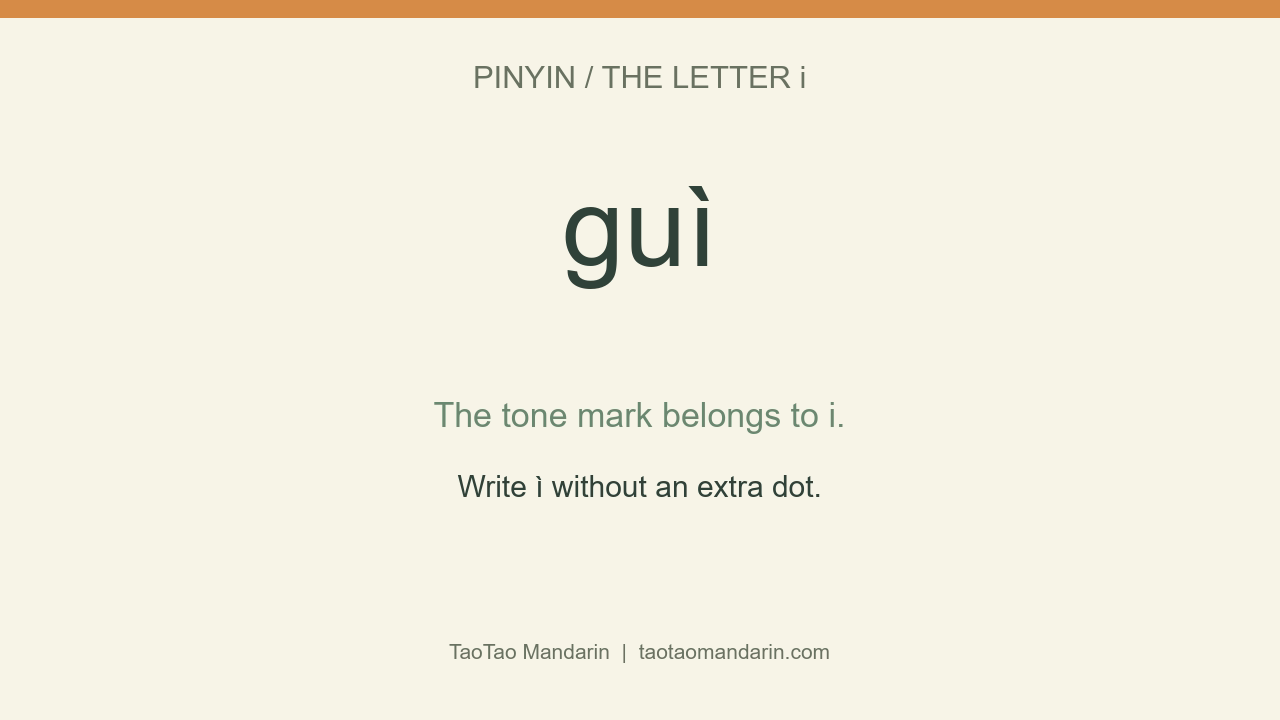
See the marked-i writing check for the full comparison.
Sources
- The Hong Kong Polytechnic University: Spelling Rules in Pinyin — iu/ui placement, abbreviated finals, and the mark on i.
- MIT: Hanyu Pinyin for Mandarin Speakers — Spelling Rules — vowel-letter tone marks and worked spelling examples.
- A learner's question about which letter takes a tone mark — a topic prompt, not the authority for the rule.
The choose-then-mark cards and error-repair routine were created for this guide. No claim about learning speed or measured pronunciation improvement is made.