Does Third-Tone Sandhi Change Pinyin Spelling?
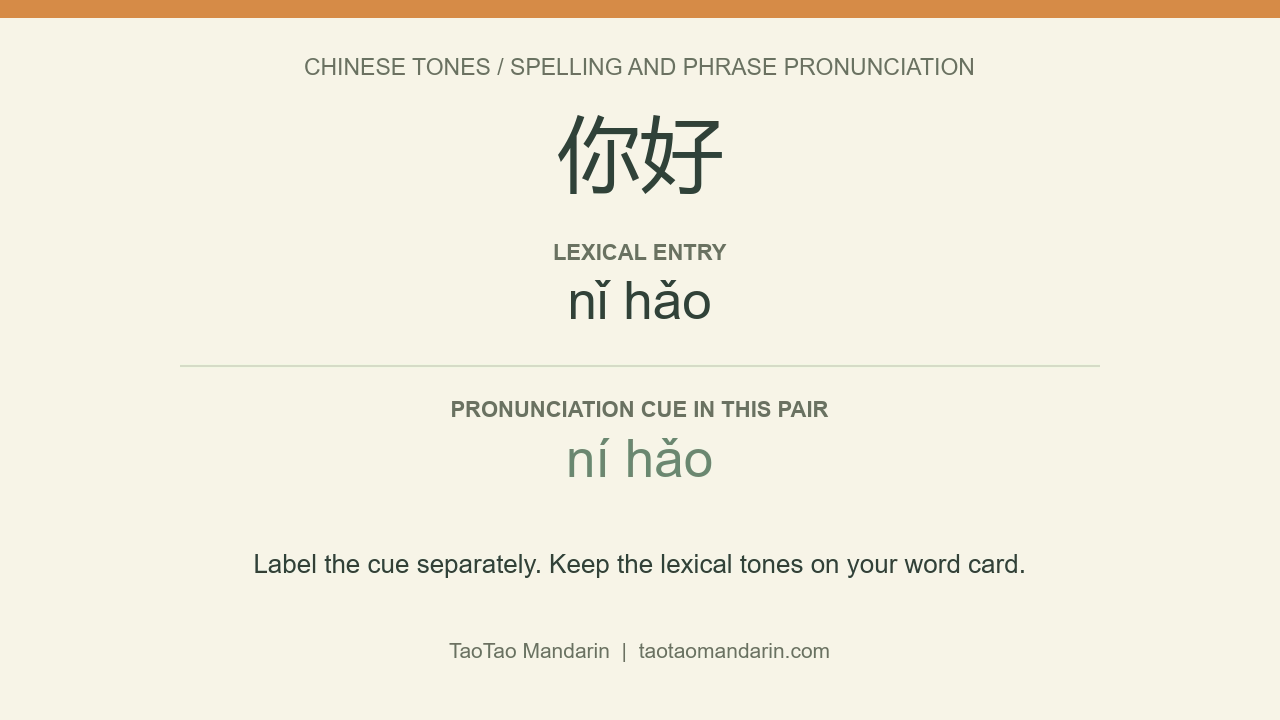
No. In ordinary dictionary-style pinyin, keep the lexical third-tone marks. In a pair of third tones, the first syllable normally takes a rising surface pronunciation. A practice note may show that change, but it should be labeled separately from the word's lexical spelling. For example, keep nǐ hǎo in your vocabulary record and use a separate reminder that the first syllable rises in this phrase.
This guide focuses on adjacent third-tone syllables. MIT's pinyin tutorial describes their pronunciation change while retaining the written tone marks. If the notation in a course looks different, check what that notation is intended to represent before changing your notes.
Listen to the phrase pairs
One speaker reads nǐ hǎo, kěyǐ, and hěn hǎo in that order. Follow the lexical forms while you listen, then compare them with the separately labelled pronunciation cues.
Watch the illustrated listening drill
Original spoken recording provided for TaoTao Mandarin. The visual cues are teaching annotations rather than measurements of this recording.
Give spelling and pronunciation different jobs
| Lexical record | Phrase cue | Use the cue for |
|---|---|---|
| nǐ hǎo | First syllable rises before the following third tone. | Practicing the greeting as a complete phrase. |
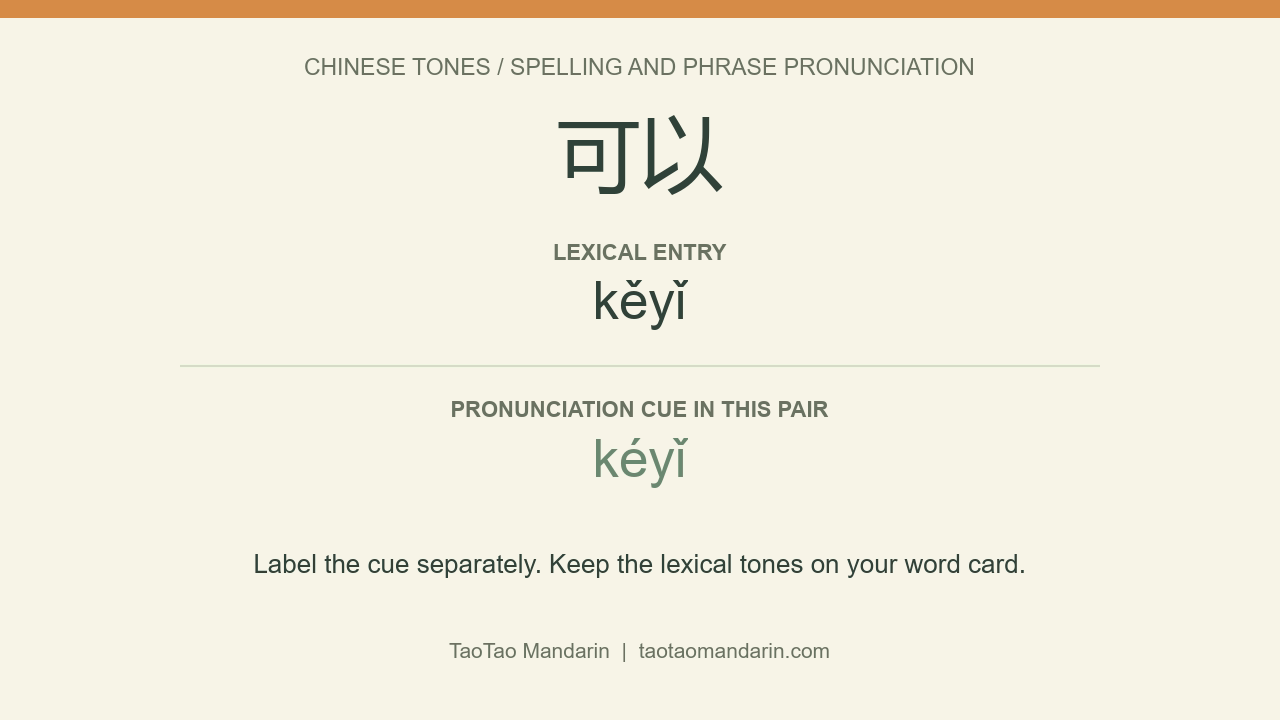
| kěyǐ | The first third tone changes in the pair. | Reading the word with its neighboring syllable. |
| hěn hǎo | Keep the word tones in memory; apply the phrase-level change. | Comparing a reference with your own complete response. |
A note such as “rising first syllable” is a pronunciation cue, not a measured pitch trace. It does not prescribe an identical contour for every speaker or a full dip-and-rise on the last syllable. For that distinction, see when a fuller third-tone contour can appear.
Build a two-column practice card
Start with a word you can identify
Choose one of the three examples above. On the left side of a card, write the lexical pinyin from a trusted reference. On the right side, write the exact phrase you will listen to and leave room for a pronunciation note. Put a clear heading over each side. That small distinction keeps a listening observation from silently replacing the spelling you wanted to remember.
Before listening, cover the right side and retrieve the lexical tones. Then uncover the phrase. Say what context the first syllable has: another third tone follows it. Your task is to connect a known word with a known context. It is not to guess an unfamiliar word's dictionary tone from one rising sound.
Add a cue without overwriting the word
Play a short, reliable recording of the full phrase. In the pronunciation column, write a brief observation or a contextual reminder, such as “first syllable rises here.” If you use a respelled practice cue, label it “pronunciation cue” and keep it beside the lexical form. Do not leave two unlabelled spellings on the card and expect yourself to remember later which one serves which purpose.
Use “not sure” if the sound is unclear. Save the recording with the phrase label so that you can ask a teacher about the same example. A rushed decision to turn every rise into a lexical second tone would make the card less reliable, not more detailed.
Check the card in both directions
First hide the pronunciation column and read the lexical entry back. Next hide the lexical column and explain what the pronunciation note tells you about the surrounding syllables. Finally show both sides and read the complete phrase with the reference. These are different checks: remembering a word, identifying its context, and producing a phrase.
If you make a mistake, name which check failed before editing the card. If you forgot the lexical tone, verify the word. If you forgot the neighboring tone, restore the full phrase. If the spelling is right but your pronunciation differs from the model, record another attempt and compare one feature. Avoid changing correct lexical pinyin merely to make it look like a rough listening note.
A quick card-repair exercise
- A card says only “ní hǎo,” copied from a teacher's pronunciation annotation. What label and lexical entry would make the card clearer?
- You know kěyǐ, but your recording sounds different from a careful isolated kě. Which column needs the phrase-level reminder?
- You hear a rise in an unknown word. What information is missing before you can enter its lexical tone?
Show the suggested repairs
For the first card, keep nǐ hǎo as the lexical entry and label the teacher's version as a pronunciation cue. For the second, keep the known lexical spelling and add a contextual note on the pronunciation side. For the third, identify the word and verify it in a reliable source; the rising sound alone does not decide its lexical tone.
The practice cards and repair exercise were created for this guide. They organize your notes and comparisons; they do not measure pronunciation accuracy.
Why does a teacher write ní hǎo in a pronunciation note?
If the notation is explicitly a pronunciation cue, ní can show the rising realization of the first syllable before another third tone. Label that cue and keep the lexical entry nǐ hǎo beside it. If a handout does not identify the purpose of its notation, ask whether it is recording lexical tones or a phrase-level pronunciation. Keep that distinction when copying it onto a flashcard.
Source and next step
- MIT: Hanyu Pinyin for Mandarin Speakers — Tones, especially the third-plus-third combination and unchanged written tone marks.
Keep the card with its phrase recording. If you want help comparing what you say with a reference, use the short self-check routine.