When Should You Pronounce the Full Mandarin Third Tone?
Use the full dip-and-rise as a careful, isolated pronunciation model—not as a shape to force onto every third-tone syllable. A fuller contour can appear when a syllable has room before a pause. But even a third tone at the end of a word or phrase can stay low in natural speech. Match the phrase and the speaker you are hearing rather than adding a rise just because a sentence ends.
If a dictionary example sounds different from a conversation, first check whether you are comparing a word spoken alone with a syllable inside a phrase. The written third-tone mark identifies the word's tone; it is not a requirement to reproduce one fixed curve in every setting.
Three checks before you add a rise
| Check | What to compare | What not to assume |
|---|---|---|
| Spoken alone | A careful reference pronunciation of the isolated syllable. | That every conversational use must copy its full contour. |
| Before a pause | The same speaker's complete phrase, including its ending. | That a pause guarantees an audible final rise. |
| Before another syllable | The target plus the next syllable, not the target cut out of context. | That a low realization means the dictionary tone has changed. |
There is a separate case before another third tone: the first third tone commonly takes a rising surface contour. That is third-tone sandhi, not a full dip-and-rise on both syllables. For a broader comparison, see the third-tone context map.
Hear the same syllable in three contexts
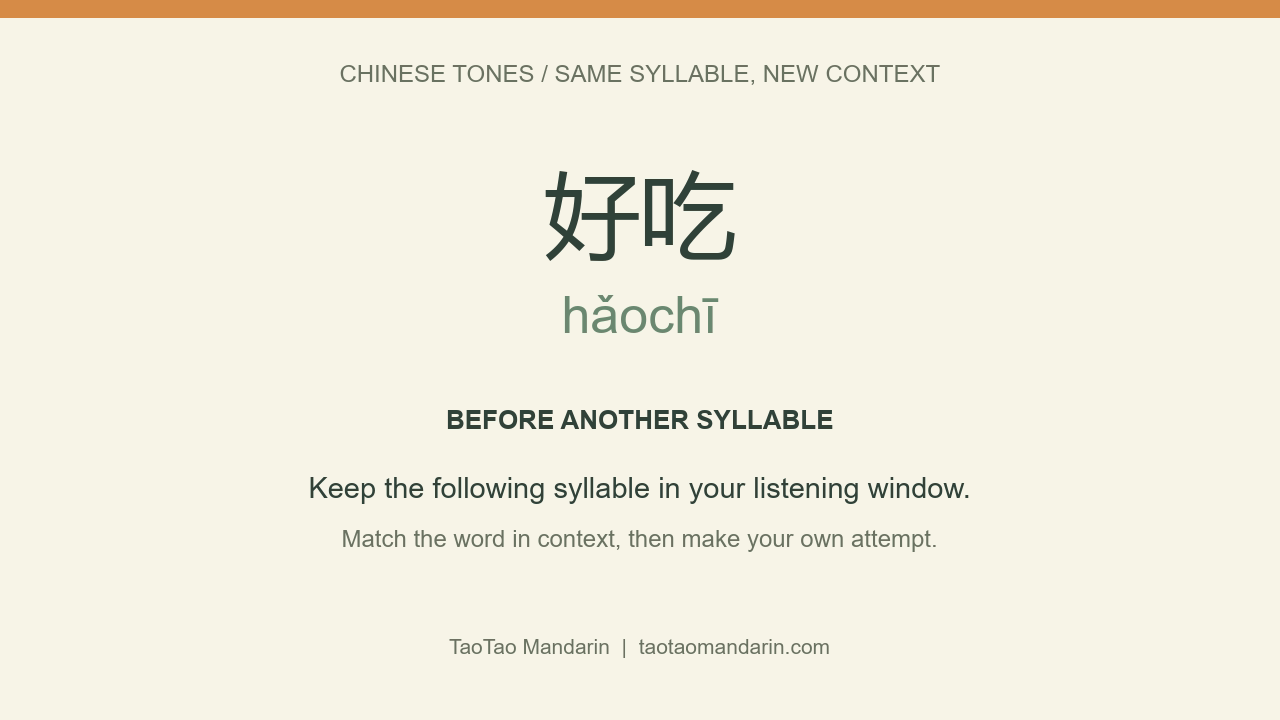
Listen to one speaker saying hǎo, zhēn hǎo, and hǎochī. Keep the whole phrase as your reference. The cards describe the contexts; they are not measurements of this recording.
Spoken example provided for TaoTao Mandarin. Watch the illustrated listening drill.
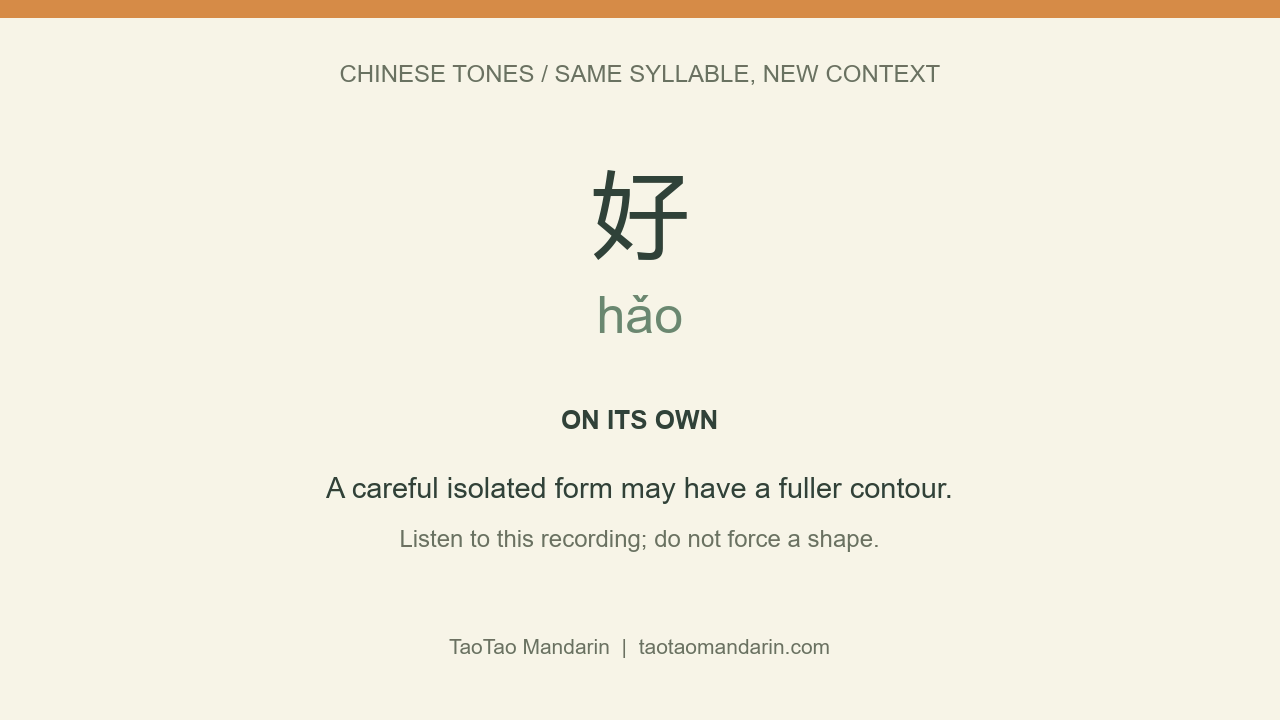
A same-syllable practice sheet
This exercise keeps the syllable hǎo constant while changing its position. The phrases below are practice prompts, not pitch predictions. Use a trusted recording or ask one fluent speaker to say them naturally. Do not ask for an exaggerated dip.
Pass one: keep the whole utterance
Prepare three short recordings: hǎo on its own, zhēn hǎo as a complete response, and hǎochī as a word. Label the files with their phrase, not with a guessed contour. Listen to each complete recording before replaying just the target syllable. In the third prompt, keep enough of chī to hear the following tone.
Write a plain observation beside each file: “low ending,” “audible recovery,” or “not sure.” Leave the last option available. A label you can explain by replaying the sound is more useful here than a guess based on the shape of the pinyin mark.
Pass two: compare only one feature
Choose the isolated hǎo and the final hǎo in zhēn hǎo. Ask whether the end of the vowel rises audibly in each recording. Do not compare loudness, total word length, and pitch height all at once. If the final example stays low, keep that observation; the exercise does not require the two recordings to match.
Now compare the isolated example with hǎochī. Track where the target reaches its low point and what happens as the next syllable begins. Resist adding a rise while you listen. You are checking the reference, not correcting it to fit a diagram.
Pass three: record the phrase, then listen back
Make one natural attempt at each prompt. Replay your attempt beside its matching reference: isolated with isolated, phrase-final with phrase-final, and phrase-internal with phrase-internal. If a difference stands out, choose one feature for your next attempt. Avoid using a long, isolated citation form as the sole target for a short conversational phrase.
Keep your original recording as well as the new attempt. A useful note is specific: “I added a rise that I cannot hear in this reference.” “My tone was bad” gives you no clear next action. This worksheet is a way to organize listening; it does not certify pronunciation or replace feedback from a teacher.
What if a phrase-final third tone stays low?
Do not treat that observation alone as an error. MIT's pinyin tutorial gives natural phrase and word examples whose final third-tone syllables need not rise. A sentence boundary is therefore insufficient evidence that a speaker must produce the complete textbook contour. Compare the actual recording and its context.
When speaking, use a comfortable range. Do not strain downward or manufacture a large upward swing to make a diagram visible. If you are unsure what you produced, save the full phrase and ask for feedback on that recording.
Does Third-Tone Sandhi Change Pinyin Spelling?
No: keep the lexical third-tone mark in ordinary dictionary-style pinyin. Third-tone sandhi describes a surface pronunciation change in a phrase. It does not automatically rewrite the word's conventional pinyin. A teacher may add a separate annotation to show the sound in that context, so check whether a notation represents the word's spelling or its current pronunciation. MIT's pinyin tutorial explicitly keeps the tone mark unchanged in its combination examples.
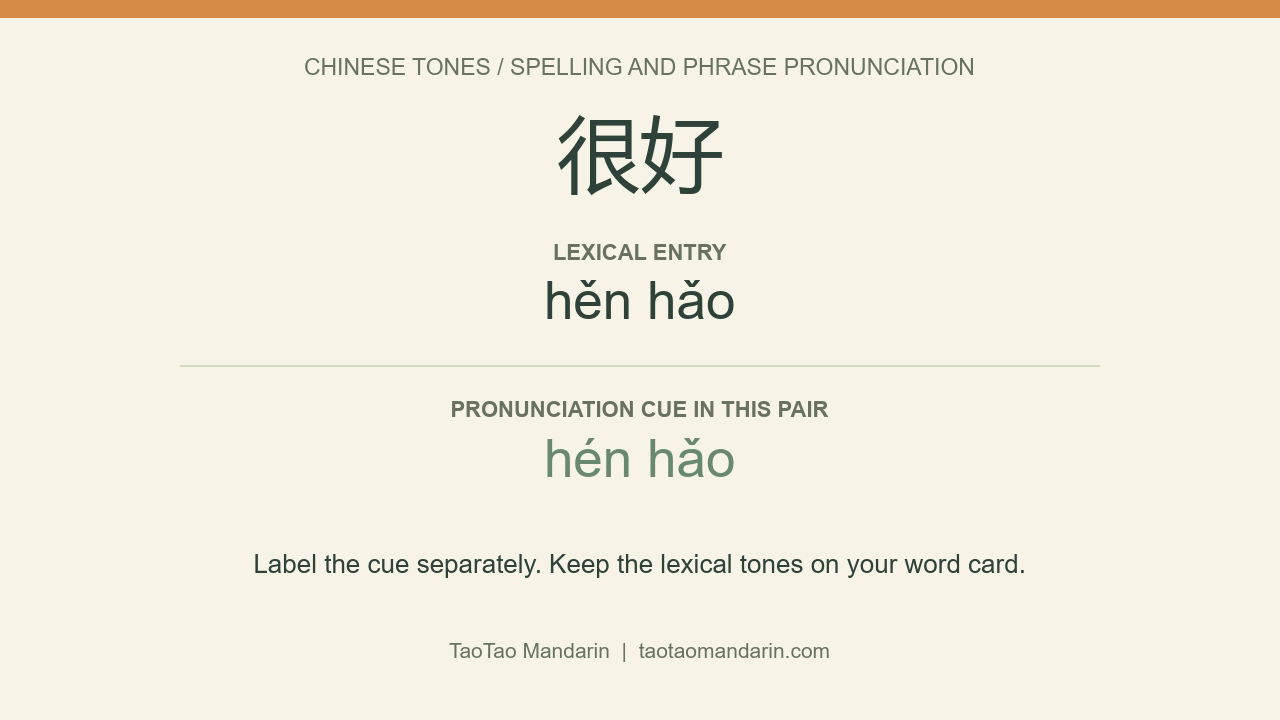
Try the two-column pinyin and pronunciation practice to keep these notations clear.
Sources and scope
- MIT: Hanyu Pinyin for Mandarin Speakers — Tones, especially the full/half third-tone and third-plus-third sections. This is the basis for the pronunciation distinctions above.
- A learner's question about third-tone difficulty supplied the topic prompt. One discussion is not evidence about learners as a group.
The comparison worksheet and recording prompts were written for this guide. No pitch measurements or learning-effect claims are presented.