Is Mandarin Third Tone Always a Dip?
No. The full falling-then-rising shape is one possible realization, not a contour you must hear on every third-tone syllable. A third tone inside a phrase is often low or low-falling before a non-third tone. Before another third tone, the first commonly surfaces with a rising contour through third-tone sandhi. A fuller rise is more likely when a syllable is said alone or at a phrase boundary, though speaker and intonation still matter. Listen for the syllable’s neighbors before deciding what its pitch means.
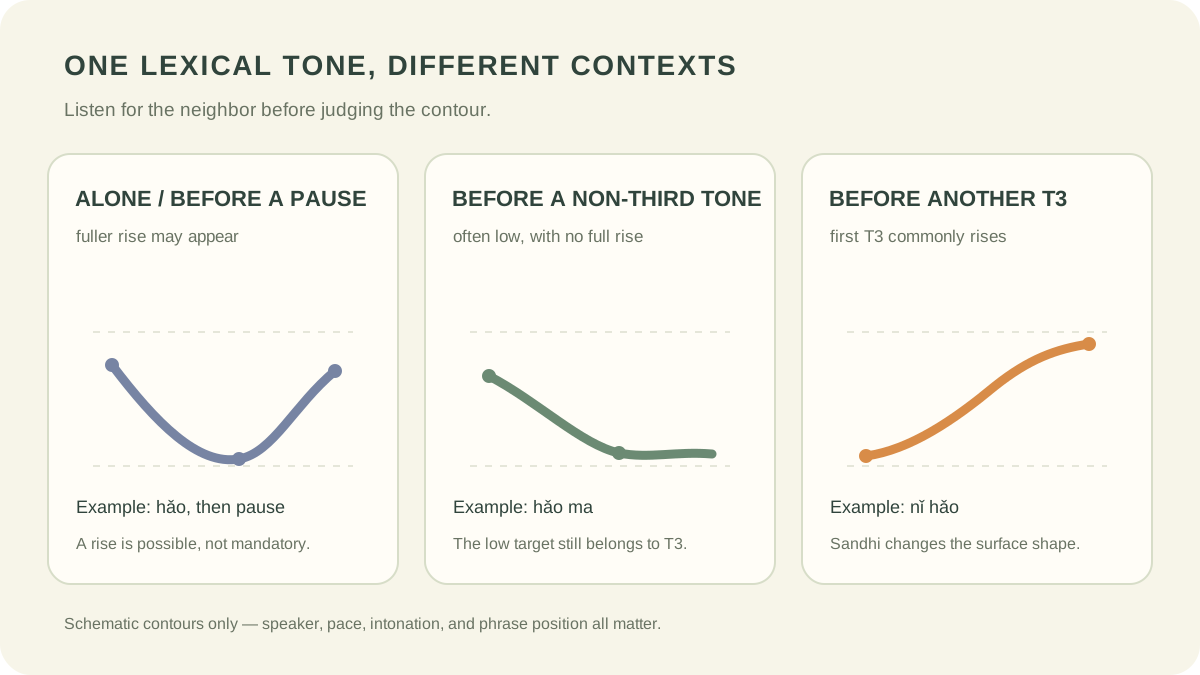
A third-tone mark identifies the word’s lexical tone. It does not promise that every recording will contain the same dramatic dip and rise. In connected speech, pitch movement is affected by neighboring tones, tone sandhi, phrase position, timing, and intonation.
Three contexts to compare
| Where you hear it | What may happen | What to listen for |
|---|---|---|
| Alone or before a pause | A fuller low-dipping or falling-rising contour may be heard, especially with careful or emphatic speech. | After the low point, does the voice move upward before the syllable ends? |
| Inside a phrase, before tone 1, 2, 4, or a neutral syllable | The third tone commonly stays low or falls without a full rise. This is often called a half third tone. | Does the target reach a low area and remain low as the next syllable begins? |
| Before another third tone | The first of two adjacent third tones commonly takes a rising surface contour through tone sandhi. Its written lexical tone remains third. | Does a rise occur before a second third-tone syllable? Use the pair, not the rise alone, to identify the words. |
These are useful patterns, not a promise that every speaker will produce a textbook curve. A phrase-final syllable can have a fuller rise, a smaller rise, or a low contour depending on how the phrase is delivered. Do not use “it rose” as the only test for tone 2.
A short listening drill
- Pick one clear voice. Use the same speaker for each replay so you are not comparing one person’s pitch range with another’s.
- Mark the lexical tone. Check a trusted dictionary or transcript before listening. Keep that answer fixed even if the spoken contour changes.
- Listen to the next syllable. Is the target isolated, phrase-final, followed by a non-third tone, or followed by another third tone?
- Replay one short chunk. Track only the target’s low point and any rise. At normal speed, write “low,” “rising,” or “fuller rise”; do not force a V shape.
- Check the context. Compare your note with the phrase and dictionary reading. If the rise appears before another third tone, consider sandhi before calling it a second-tone word.
Quick self-check
Listen for the target in hǎo ma, then in nǐ hǎo. Ask which following syllable changes what you expect from the first third tone. The first phrase has a third tone before a neutral syllable; the second has two adjacent third tones, so the first commonly rises. After listening, verify the words and tones in a pronunciation reference.
Use the pinyin examples as listening prompts. The contour sketches show schematic pitch shapes.
Why the dip can be misleading
- Textbook arrows are simplified. They are useful for learning a citation form, but they cannot show every tone in a sentence.
- A low third tone is still a third tone. The missing rise in a phrase does not erase its dictionary tone.
- A rise is not unique to lexical tone 2. A third tone before another third tone can rise because of the sequence.
- Pitch height is relative. Listen to the contour within the same speaker instead of trying to match someone else’s exact pitch.
Common question: Why does third tone sound different from one word to another?
A beginner learning HSK 1 wrote: “I’m finding the third tone a bit hard and it sounds different from one word to another.” The sound can change because a tone mark gives the word’s lexical tone, while the syllable’s surface contour depends on what follows and where the phrase ends. Check the word in a reliable pronunciation source, then compare it in a short phrase with the same speaker. If another third tone follows, expect the first to rise more often; if a non-third tone follows, listen for a low target instead of a full dip. Save the word and its phrase audio together so you do not have to infer an unfamiliar word from pitch alone.
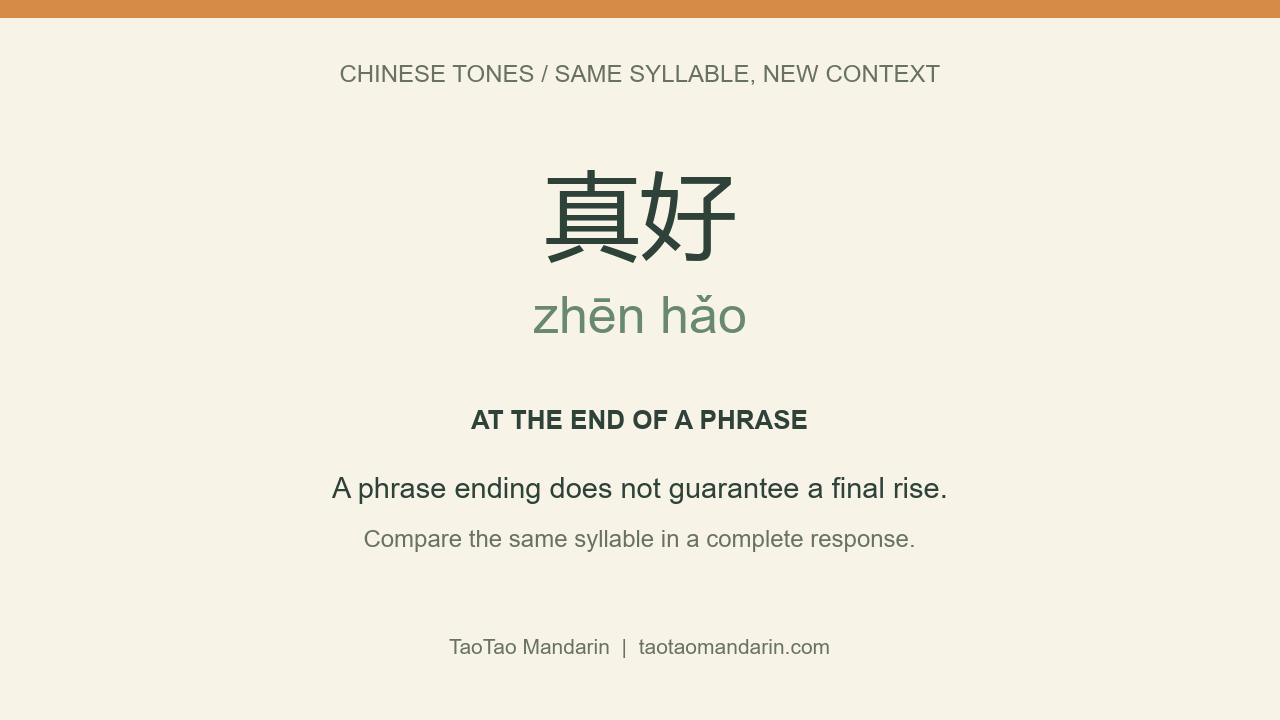
Hear one speaker compare these positions in the same-syllable recording practice.
Takeaway
Mandarin third tone is not always a full dip. First identify the word, then check where the syllable sits in the phrase and what follows it. A short, context-matched replay tells you more than insisting on one contour everywhere.
Sources
- The Open University, “Beginners’ Chinese: a taster course — 1.3 Tones” — canonical tone-mark descriptions and listen-and-repeat examples.
- Chen, Liu & Kager, “Perception of Different Tone Contrasts at Sub-Lexical and Lexical Levels by Dutch Learners of Mandarin Chinese” — describes low-falling and rising third-tone variants in connected speech contexts.
- “Adaptation in Mandarin tone production with pitch-shifted auditory feedback” — reviews how third-tone contours differ between citation and non-final connected-speech positions.
- A learner question about third tone sounding different across words — one person’s experience, used as a topic prompt rather than evidence about learners generally.