How to Check Your Mandarin Tones Without a Teacher
You can use a short recording to spot a likely tone mismatch, even when you are studying alone. Listen once without the answer, check the word against a reliable pronunciation reference, then record and compare the same short phrase. Focus on one feature at a time—rise, fall, low target, or timing. This is a self-check, not a substitute for feedback from a knowledgeable speaker.

A learner asked how to tell whether a tone sounds right while speaking aloud, especially when the practice voices are hard to hear. The useful shift is from repeating a tone chart to comparing one short, known phrase with one clear reference.
The three-pass recording check
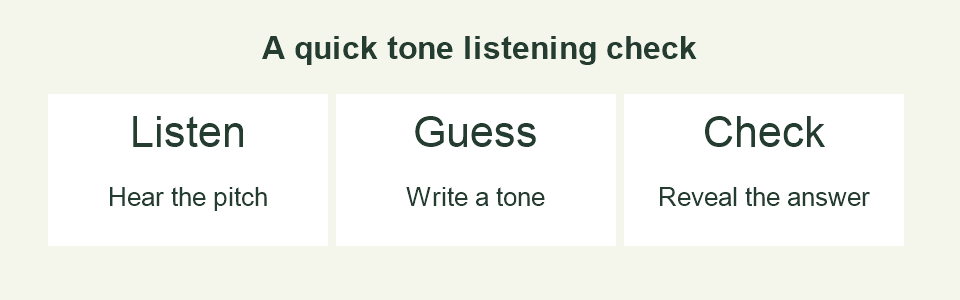
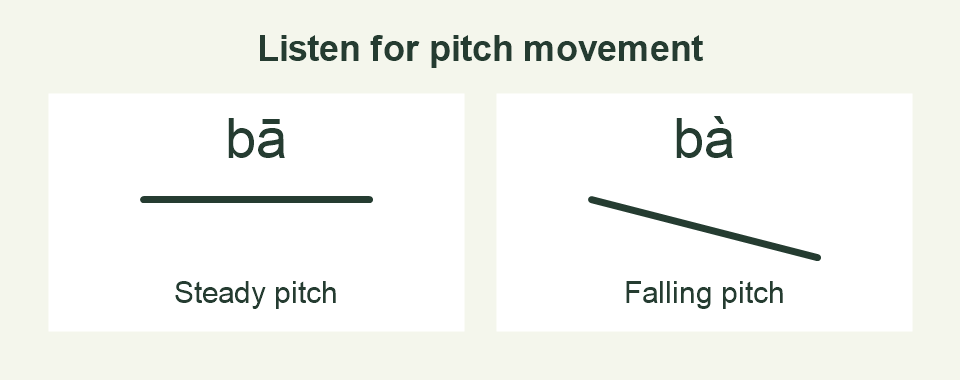
- Listen before you look. Choose a clear, short clip you can replay. Listen once, then jot down which syllable carries the contrast and what you heard: level, rising, low, or falling. Do not grade yourself yet.
- Check the word and context. Look up the word in a trusted dictionary or course transcript. Mark its citation tone, then listen again in the original phrase. Do not expect every tone to keep its isolated shape in connected speech; tone contours can vary with neighboring syllables and speaking context.
- Record one matched attempt. Repeat the same phrase at a comfortable pace and record it. Compare your clip with the reference at normal speed, then replay once. Note one difference you can work on, such as a rise that stops early or a low syllable that is too high.

For a familiar example, compare a careful, isolated nǐ with nǐ hǎo in a connected phrase. Both syllables have third-tone dictionary forms, but adjacent third tones interact in standard Mandarin. That is why the written tone mark alone does not tell you exactly what pitch trace to expect in every sentence.
Use a small listening record
Save the reference and your own attempts together. A useful note describes the sound you noticed, not a vague score such as “bad tones.”
| Pass | Write down | Next adjustment |
|---|---|---|
| First listen | Which syllable stood out? What contour did you hear? | Replay the same word in a short phrase. |
| Reference check | Dictionary tone and the phrase where you heard it | Keep lexical tone separate from its contextual realization. |
| Your recording | One specific contrast from the model | Repeat the phrase while changing only that feature. |
One-minute drill
- Pick one short phrase from a lesson with a clear speaker.
- Listen once, then write your best guess for the target syllable.
- Check the transcript or dictionary and replay the model.
- Record your own version and compare only the target syllable.
- Keep both recordings; next time, check whether the same feature is easier to hear.

What this self-check can—and cannot—tell you
A recording lets you compare your own production with a reference and notice a repeatable difference. It cannot prove that every syllable is correct: your playback can sound unfamiliar, pitch movement changes in connected speech, and a single model represents one speaker and accent. If you keep hearing the same mismatch, ask a Mandarin teacher or proficient speaker to listen to that exact phrase and tell you what they hear.
Mandarin tone descriptions are usually introduced with isolated syllables, while connected speech can change their surface pitch and duration. The Open University’s beginner lesson provides the basic tone contours and listening activity; research on Mandarin tone perception also discusses how contours vary in connected speech. Use the isolated model to learn the contrast, then check it in a phrase rather than forcing every syllable into a diagram.
How do I know if I am saying a Mandarin tone correctly?
Start with a clear reference for the same word or phrase. Record one attempt, compare the target syllable, and name one difference you can hear. If you cannot tell whether your production matches the model, that is a useful signal to seek feedback—not evidence that you are tone-deaf or that you should stop learning vocabulary.
Takeaway
Use three passes: listen without cues, verify the word and context, then record and compare one short phrase. Keep the clips and work on one audible feature at a time. Self-recording makes practice more deliberate; a qualified listener can help confirm what your own playback cannot.
Sources
- The Open University, “Beginners’ Chinese: a taster course — 1.3 Tones” — tone contours and a listen-and-repeat activity.
- Han et al., “Perceptual Confusion of Mandarin Tone 3 and Tone 4” — discusses tone contour variation in connected speech.
- Learner question on Reddit — one learner’s question about checking spoken tones; used as an individual example, not a survey.