Why Does the Dot Disappear from i in Pinyin Tone Marks?
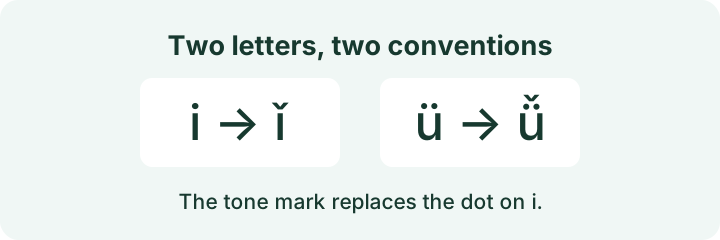
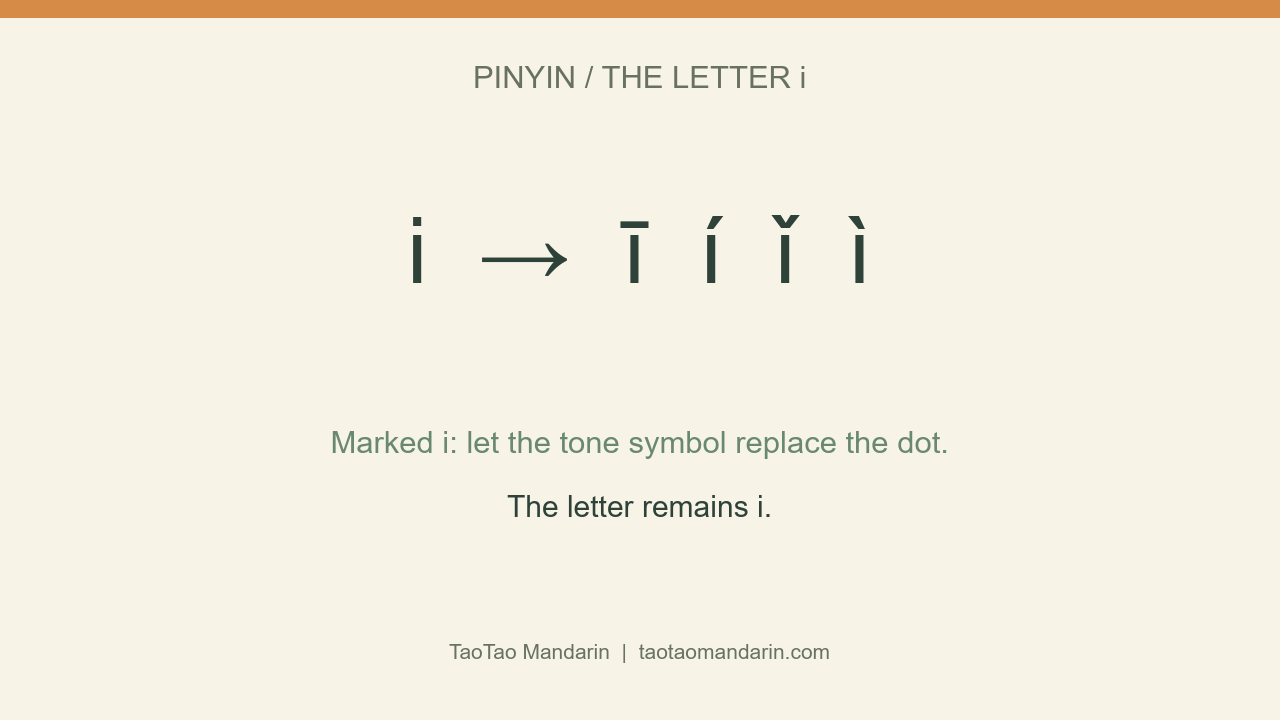
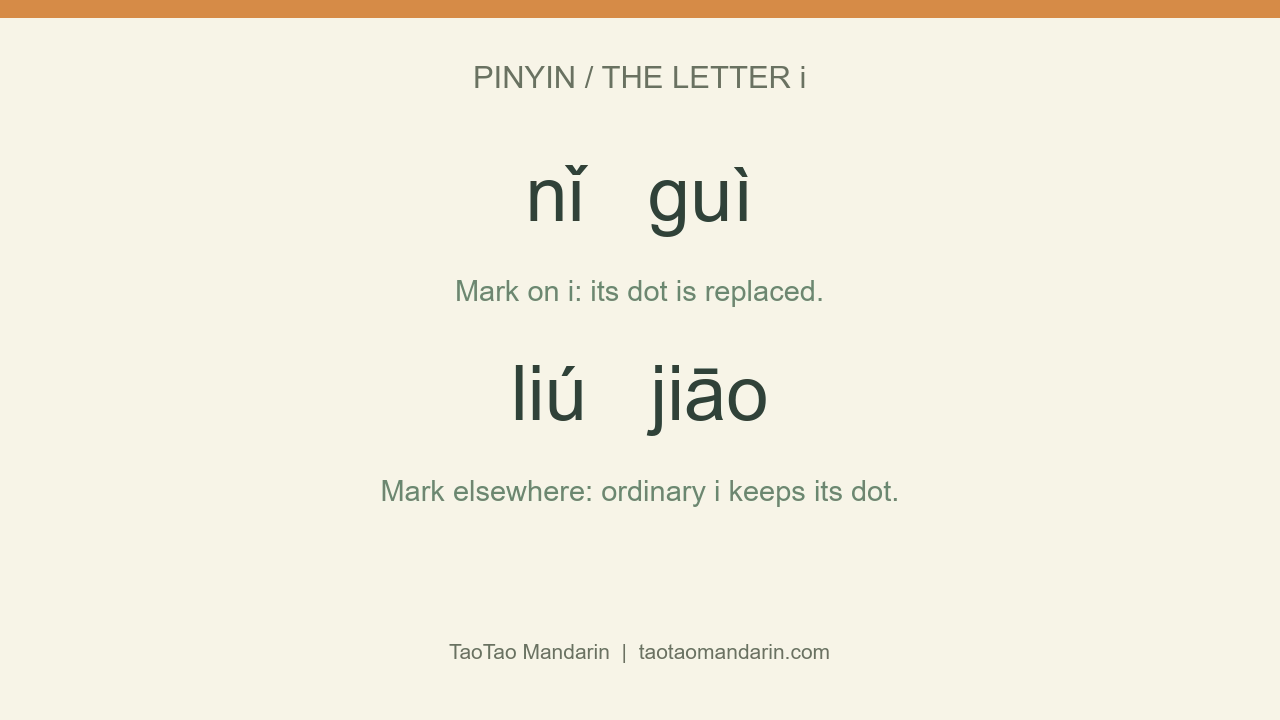
When a tone mark is placed on lowercase i in pinyin, it replaces the dot. The resulting forms are ī, í, ǐ, ì. This is a spelling convention: the letter is still i. If the tone mark belongs to a different vowel, an ordinary unmarked i keeps its dot, as in jiāo and liú.
The task is not to remove every dot you see in a pinyin word. First decide which vowel receives the tone mark. Only then check the shape of that letter. A small spelling check can therefore stay separate from remembering the word's lexical tone or practicing its sound.
Hear the examples and follow the spelling
The supplied recording follows yī, yí, yǐ and yì. Each example has its tone mark on i. Compare the written forms while listening to the complete syllables.
Watch with the written examples
Compare where the mark actually sits
| Written form | Marked vowel | What happens to i? |
|---|---|---|
| nǐ | i | The third-tone mark replaces its dot. |
| guì | i | The fourth-tone mark replaces its dot. |
| liú | u | The unmarked i keeps its ordinary dot. |
| jiāo | a | The unmarked i keeps its ordinary dot. |
The Hong Kong Polytechnic University and MIT both state the rule about omitting the dot when the mark is on i. For the separate choice of marked vowel, see the iu/ui placement exercise.
A mark-first, dot-second worksheet
Locate the marked vowel
Write four prompts on a sheet: ni3, gui4, liu2, and jiao1. The tone numbers are supplied for this writing exercise. Underline the vowel that receives each mark before drawing any accent. Leave the other letters alone. You are making a placement decision first, so do not start by erasing the dot from every i.
Read your underlines back as i, i, u, a. If a choice differs, check the placement rule for that final. Keep the tone number unchanged while correcting the chosen vowel. This makes the repair specific: you can see whether you forgot a word's tone or simply selected the wrong letter for its symbol.
Finish only the selected letter
Convert the supplied numbers into tone marks. When your selected letter is i, write its marked form with the tone symbol taking the dot's place. When your selected letter is u or a, finish that vowel instead and keep the ordinary i in the rest of the syllable. Compare the whole result with a clear typed reference.
Use two short labels beside each answer: “mark on ___” and “i marked / i unmarked.” Fill both in rather than judging the word by its overall appearance. For example, a missing dot in an unmarked i needs a different repair from an extra dot kept under a tone mark on i.
Copy once, then check your own decision
Cover the answers and make a fresh copy of each completed form. Uncover the reference and look at just the marked vowel first. Then inspect any other i in the syllable. Keep the first attempt next to the correction so that you can identify what changed. Avoid repeatedly copying the same unclear shape without checking its role.
For a final transfer prompt, use yi1. Choose the marked vowel, write the result, and explain what happened to the ordinary dot. Next return to liu2 and explain why its i is different. This comparison checks whether you followed the mark's location rather than memorizing one word's silhouette. It is a writing task and does not grade spoken tone accuracy.
Show the written answers
The prompts become nǐ, guì, liú, jiāo. The first two have the tone mark on i; the latter two have the mark elsewhere and retain a dotted i. The transfer prompt is yī.
Keep a clear spelling with a spoken example
Use an identified word and its recording when you practice pronunciation. A missing ordinary dot under a tone mark is not a signal to change the consonant or add a separate sound. Keep the writing check focused on the letter shape, then listen to the complete syllable as a separate task.
For typing, choose a complete correctly marked vowel from a reliable pinyin input method or a checked reference. An unmarked dotless character is not a substitute for completing the tone mark. Check your final word rather than assuming a font's appearance proves the spelling is right.
Does the i lose its dot in jiāo?
No. In jiāo the tone mark belongs to a, so the unmarked i keeps its normal dot. In nǐ or guì, the mark is on i itself and replaces that dot. Locate the marked vowel before deciding what to do with the i.
Sources
- The Hong Kong Polytechnic University: Spelling Rules in Pinyin — omitting the dot when i receives a tone mark, plus placement examples.
- MIT: Hanyu Pinyin for Mandarin Speakers — Spelling Rules — the explicit i-dot rule and worked spellings.
The worksheet and checking routine were written for this guide. No learning-rate or pronunciation-accuracy measurement is claimed.