Chinese Words With Neutral Tone: Listen and Compare
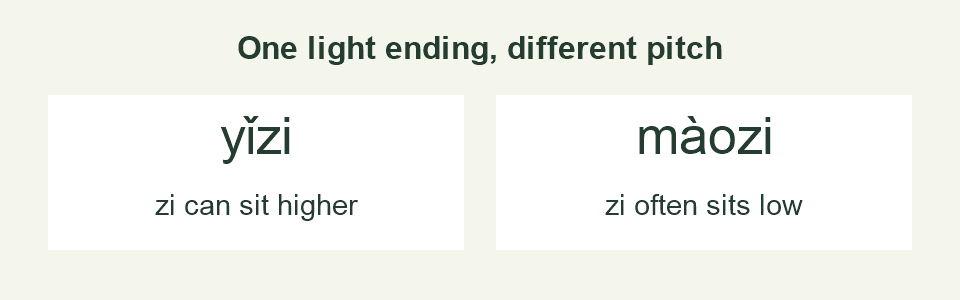
In words such as zhuōzi, yǐzi, and màozi, the final zi is usually short and light. Its pitch depends in part on the preceding tone. Listen to how the same ending sits lower after mào and can sit higher after yǐ.
Hear the same ending after different tones
These clips use synthesized Mandarin. Play the first and last examples back to back, then listen to the middle example. Focus on how long zi lasts and where it sits relative to the preceding syllable.
Table · zhuōzi
Chair · yǐzi
Hat · màozi
Use duration and context as clues
The neutral tone has no tone mark in standard pinyin. In a word like lìzi (“chestnut”), the preceding fourth tone falls and the light ending tends to be low. After a third tone, as in yǐzi, the ending can sound higher. Listen to the whole word before assigning a tone to the final syllable. Stress, pace, and sentence intonation can shift what you hear.
| Word | First tone you hear | Light ending |
|---|---|---|
| zhuōzi | High and level | zi |
| yǐzi | Low third tone | zi |
| màozi | Falling fourth tone | zi |
Use it when choosing an object
At a furniture shop, the seller asks Nǐ yào nǎ bǎ yǐzi? (“Which chair would you like?”). Reply Wǒ yào zhè bǎ yǐzi. (“I want this chair.”). Listen for how the word yǐzi fits into both lines. The light syllable belongs to the word even when the rest of the sentence changes.
Try the shop listening check
Choose the word before opening the answer
Imagine that you are helping a friend find things in a shop. Each clip contains one word from the table. Listen once and write the object you heard. Then replay the clip and mark the last syllable as the light zi you hear in the reference examples. Use the first syllable to identify the object.
Clip A
Reveal answer
Màozi, hat. Listen for the falling mào followed by a short zi.
Clip B
Reveal answer
Yǐzi, chair. Notice the low part of yǐ and how the next syllable can sit higher even though it is light.
Keep the ending light when the sentence changes
Point to an object in your room and say Wǒ yào zhè bǎ yǐzi. Then say the same sentence with nà (“that”) in place of zhè. Keep the word yǐzi together on both tries. If the ending sounds like a separate beat, return to the reference clip and repeat the two syllables as one word before going back to the sentence.
Try the same routine with màozi. Say Wǒ yào zhè dǐng màozi (“I want this hat”), then change zhè to nà. Record your two sentences if you can. On playback, compare just the endings. You should hear a clear first syllable and a shorter ending without having to force both words to end at the same pitch.
Does the neutral tone have a pitch?
Yes. You can hear a pitch on the light syllable. In màozi, the final zi often sits low after the falling tone. In yǐzi, the final zi can sit higher after a low third tone. In both words the ending is light, and pinyin leaves it unmarked.
For another example, compare the light ending in jìde.