Why Does 得 Sound So Light in 记得?
In the standard dictionary reading, 记得 is jìde, with a neutral second syllable. So if 得 sounds short and light rather than like a full rising dé, you may be hearing it correctly. The Ministry of Education’s Revised Mandarin Chinese Dictionary lists 記得 as jì de and marks 得 as neutral. This is the pronunciation of this word; it is not a general rule that every second tone turns neutral. See the dictionary entry.

When a sound in a real recording seems to disagree with a tone chart, first check the whole word. Chinese characters can take different readings in different words, and 得 is a particularly easy character to misread.
One character, several readings
Do not decide how to say 得 from the character alone. Compare these phrases as words:
| Phrase | Pinyin | Meaning and sound |
|---|---|---|
| 记得 | jìde | “Remember.” The dictionary lists a neutral second syllable. |
| 得到 | dédào | “Obtain.” Here 得 is the full second-tone verb dé. |
| 我得走 | wǒ děi zǒu | “I have to go.” Here 得 is děi. |
| 跑得快 | pǎo de kuài | “Run fast.” 得 links an action to a description and is neutral. |

The helpful unit is the word or grammar pattern, not the isolated character. In 记得, 得 belongs to the listed word “remember”; it is not the same construction as the particle in 跑得快. The reference Modern Chinese 800 Words explicitly distinguishes 得 in words such as 记得 from the post-verb particle pattern. Read the reference entry on 得.
Is the sound changing because of tone sandhi?
For this example, learn the pronunciation of 记得 as a whole: jìde. The dictionary records a neutral second syllable in the word. That is more precise than memorizing “second tone becomes neutral,” which would incorrectly suggest that a general change happens to any second-tone syllable.
Neutral syllables are typically shorter and unstressed. Their pitch is shaped partly by the syllable before them, so the pitch you hear is not a fixed rising contour. Keep jì clear, then let de stay brief and light. If you are matching a specific accent or classroom standard, use that course’s audio model; one clip cannot tell you how every Mandarin speaker says a word.
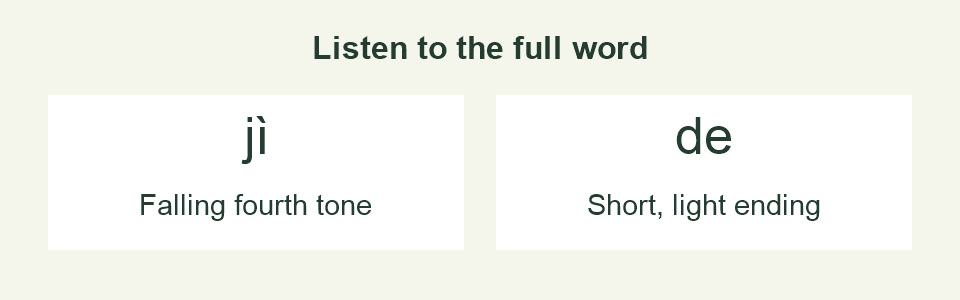
Try a short listening drill
- Hear the whole word. Say jì-de with a clear first syllable and a short second one. Avoid adding a full, deliberate rise to de.
- Place it in a phrase. Try Wǒ jìde nǐ de míngzi (“I remember your name”) and Jìde dài sǎn (“Remember to bring an umbrella”). Keep the syllables connected.
- Contrast it with another word. Say jìde, then dédào. Listen for the brief neutral syllable in the first word and the full rising dé in the second.
- Make one recording. Compare your phrase with a reliable model at normal speed. Ask whether the second syllable is light and connected, rather than trying to force a dramatic pitch shape.
The point of the drill is not to imitate one speaker’s exact pitch. It is to recognize the word’s standard reading and keep the neutral syllable from becoming an over-enunciated, full second tone.
Why does the 得 in 记得 sound like a neutral tone?
A learner heard 记得 as jìde rather than jìdé and wondered whether this was normal or a listening mistake. The standard dictionary entry supports jìde: the second syllable is neutral in this word. So the light sound is expected; it is not a general second-tone change rule. Compare the whole words 记得 and 得到, and check the pronunciation listed for the word you want to say. The question came from one learner discussion, not a survey of Mandarin learners.
Takeaway
The standard dictionary form of 记得 is jìde. The light sound of 得 is expected in that word. Keep it distinct from dédào and wǒ děi zǒu, and learn the character through real words rather than assigning it just one tone.
Sources
- Ministry of Education, Revised Mandarin Chinese Dictionary: 記得 — lists jì de and marks the final syllable as neutral.
- Modern Chinese 800 Words — distinguishes 得 inside 记得 from the post-verb particle use.