Why Does Mandarin's Third Tone Sound Low in Conversation?
In ordinary connected speech, Mandarin's third tone is often a short, low half-third tone, so it may not make the full dip-and-rise shown in a tone chart. A clear rise is more likely when the syllable is isolated, emphasized, or at the end of a phrase. When two third-tone syllables meet, the first normally changes toward a rising tone: 你好 is commonly spoken closer to ní hǎo. Listen for the syllable's place in the phrase before deciding that its tone has disappeared.
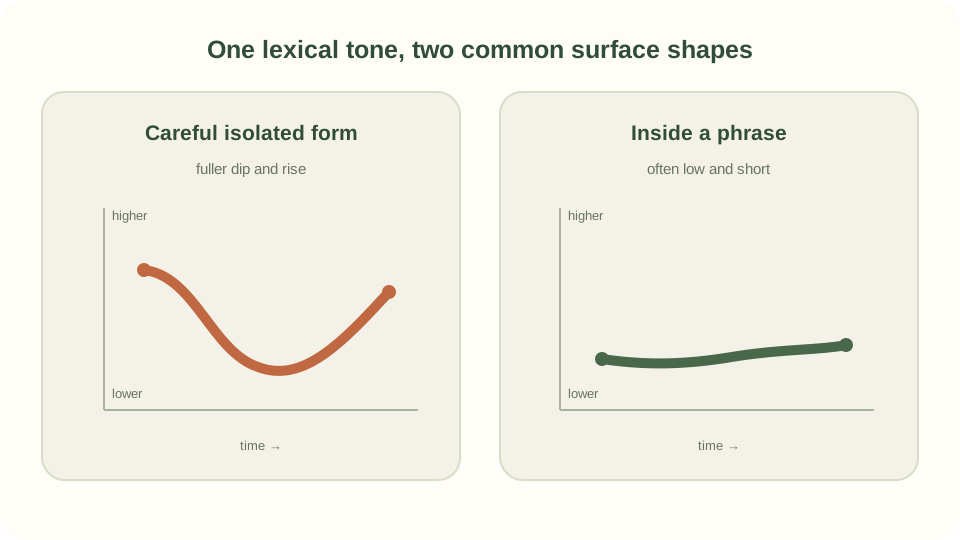
One tone mark, different spoken shapes
The caron in Pinyin (ǎ) names a lexical tone; it does not promise that every spoken third-tone syllable will trace the same dramatic curve. In a careful pronunciation drill, a speaker may lower the pitch and bring it back up. In a phrase, the same syllable often stays low and moves on to the next sound without a large rise. The written form remains third tone even when the spoken contour is reduced.
This is why a textbook recording and a conversation can seem to disagree. The chart isolates a sound so you can notice its category. Conversation connects syllables, compresses unstressed material, and places pitch movement across a phrase. A learner discussion describes the resulting confusion as the third tone sounding different from word to word; that question is useful as a listening prompt, but one post is an individual account, not a measure of how all learners feel. Read the learner question.
Check the next syllable and the pause
Use this quick decision path instead of forcing a full dip on every third tone:
- Is the syllable alone or strongly emphasized? A fuller fall-and-rise may be heard. Keep it controlled; do not add a large theatrical bounce by default.
- Does another third tone follow in the same spoken unit? The first one normally changes toward a rising contour. In 你好 (nǐ hǎo), the first syllable is commonly heard as ní before the low third tone in hǎo.
- Does a non-third tone follow without a pause? Start the third tone low and let the phrase continue. For example, in 老师 (lǎoshī), the first syllable is commonly low rather than a complete dip followed by a rise.
- Is there a phrase boundary? A pause can change what the listener hears. Compare a deliberate, isolated 好 (hǎo) with 好的 (hǎo de) in a naturally connected phrase; do not infer a spelling change from the contour alone.
A three-context listening check
Try the same syllable in three contexts. First, say 好 slowly by itself and notice whether you add a rise. Next, say 你好 as one smooth greeting and keep 你 from carrying a full isolated contour into the next syllable. Finally, say 我很好 (wǒ hěn hǎo) at a comfortable conversational pace. Listen back and mark each third tone as “full/clear,” “low/short,” or “first of two third tones.” These are listening labels for this exercise, not additional tone categories.
Then repeat the check with a recording from a speaker you trust. Compare the syllable before and after the following sound, not just the pitch trace of one syllable cut out of context. If you hear a low tone, first ask what follows and whether there is a pause. This separates a normal connected-speech shape from a tone error.
What to practise
Keep the citation tone in your vocabulary notes, but practise it inside the word and phrase where you need it. A useful sequence is: hear the whole phrase, imitate its rhythm, say it once without reading Pinyin, then check the target syllable. Do not turn “third tone is low” into a new absolute rule: the low half-third tone is common, while emphasis, phrase position, and neighboring tones can change what you hear.
Common questions
Does the third tone stop being third tone when it sounds flat?
No. The underlying tone remains third tone. The surface pitch often has only the low portion in connected speech; the written Pinyin tone mark does not change.
Should I pronounce the rise in 你好?
Usually, the first of the two adjacent third tones changes toward a rising tone, while the second stays low in ordinary speech. Practise the pair as one phrase rather than adding a large rise to both syllables.
Why does my recording sound different from a tone chart?
A chart often presents an isolated, careful form. Your recording may contain a syllable inside a word or phrase, where timing and neighboring tones shape the contour. Compare like with like: an isolated syllable with an isolated model, and a phrase with a phrase.
For a broader foundation, continue with the four Mandarin tones and the speaking practice guide.