Why Is There No Ü in Ju, Qu, and Xu?
After j, q, and x, pinyin writes the ü sound as u. The plain u sound does not occur after those initials in standard Mandarin, so the dots can be omitted. The tone mark still follows the usual rule. Compare qù and kù: both have fourth tone, and their vowels differ.
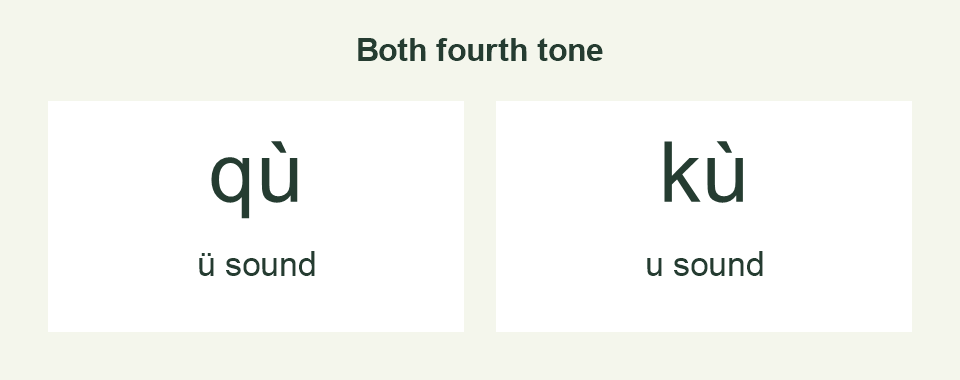
Compare the vowels at the same tone
| Ü sound | Plain u sound | Shared tone |
|---|---|---|
| jū | zhū | First |
| qù | kù | Fourth |
| xū | shū | First |
After n or l, the two written vowels can distinguish syllables, as in lǜ and lù. See how tone marks work when ü keeps its dots.
Try a read-and-write check
Read the first consonant before the vowel
Copy qù, kù, xū, shū, jū, zhū onto a sheet. Circle each complete initial. Treat sh and zh as units so their second letters do not distract you. Then add a pencil note under each syllable to indicate which vowel sound you expect. Leave the printed pinyin unchanged.
Say each pair in order. Hold the tone steady within a pair and move your tongue forward for the ü member. Start from the tongue position for i and round your lips if you need help finding ü. On the next pass, cover your pencil notes and make the vowel decision from the initial alone.
Transfer the rule to a longer final
Take xue2 and lüe4. First write the accented syllables. Then underline the vowel carrying the tone mark and circle the letter that begins the final. This gives you two independent checks. The accent tells you about tone and the initial helps you interpret the written vowel.
Check your answers
The vowel sounds for the first list alternate ü, u, ü, u, ü, u. The last two spellings are xué and lüè. Both accents belong on e. Both finals begin with the ü sound, with visible dots in lüè.
Why not write ü instead of u in words like ju, qu, or xu?
After j, q, or x, the spelling u already points to the ü sound. For example, the standard spelling is qù. Write the fourth-tone mark on u and read the vowel with the tongue forward and lips rounded.