Does Ü Keep Its Dots When a Tone Mark Is Added?
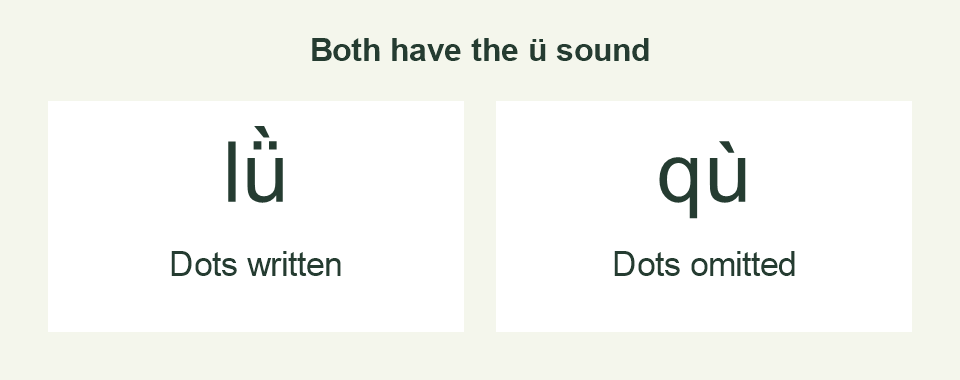
Yes. If the syllable is spelled with ü, keep its two dots and add the tone mark above them. The four forms are ǖ, ǘ, ǚ, and ǜ. Compare lǜ with lù. Both show the fourth tone, but only lǜ has the ü vowel. In qù, the dots are absent because the standard spelling after q already uses u for that vowel.

Read the vowel and the tone separately
In nǚ and nǔ, the caron gives the same tone. The dots distinguish the written vowels. The same comparison works with lǜ and lù, where the grave accent gives the same fourth tone. Compare this with the separate convention for lowercase i.
A two-pass writing check
Copy these numbered prompts on paper: nü3, nu3, lü4, lu4, and qu4. Circle the written vowel in each before adding any accent. Draw a small box beside each prompt and write either “two dots” or “no dots” in it. Decide by looking at the spelling rather than the tone number.
Now add the tones. Give the first pair a caron and the second pair a grave accent. Put the grave accent on the written u in qu4 too. Compare your five answers from left to right: nǚ, nǔ, lǜ, lù, qù.
Cover the prompts and swap only the vowel in lǜ. Your result should be lù. Start again from lǜ and change only the tone to the third tone. Your result should be lǚ. Explain which change affected the dots and which affected the accent. Repeat with nǚ and see if you can make the same distinction without looking at the example.
Does the tone mark replace the dots in lǜ?
No. In lǜ, the dots identify the vowel ü, and the grave accent marks the fourth tone. Taking away the dots produces lù, a different syllable with the same tone.