Chinese Tones Listening Test: Hear All Four Mandarin Tones
Listen for four pitch movements: high and level, rising, low, and falling. Hear the reference clips, choose a tone for each test clip, then check your answer and try the same skill in a short greeting.
A learner’s Reddit post titled “Tones” asks whether difficulty hearing or saying tones should be a reason to worry. That post is one person’s experience, not a measure of how common the problem is. For your own practice, a more useful question is narrower: did I miss the sound, forget the word, or know the answer but have trouble saying it?
Hear the four reference tones
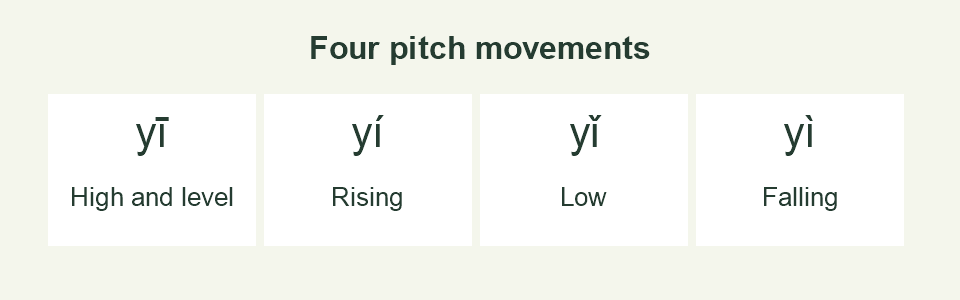
The reference and quiz clips use synthesized Mandarin. Each reference uses the same syllable, yi. Listen for the movement in its pitch.
Tone 1 · yī
High and level
Tone 2 · yí
Rising
Tone 3 · yǐ
Low, with a possible rise in isolation
Tone 4 · yì
Falling
Listen for pitch before you guess
On the first pass, label what you hear: high and steady, rising, low, or falling. Then match that movement to a tone number. If the first and fourth tones blur, listen to the ends of yī and yì. Both begin high, but the fourth tone falls. If the second and third tones blur, listen for how low the sound goes before the end. Compare with yí and yǐ again.
Take the listening test

Each clip uses the syllable ma. Write down a tone number before opening each answer. Then give yourself one point for each first guess that matches. Keep a note of which tones you swapped, so you can choose one pair to replay.
Clip A
Reveal answer
Tone 4 · mà. Listen for the drop from a higher note.
Clip B
Reveal answer
Tone 2 · má. The end is higher than the start.
Clip C
Reveal answer
Tone 1 · mā. The note stays fairly steady.
Clip D
Reveal answer
Tone 3 · mǎ. Listen for the low part of the syllable.
Move from the test to the greeting below. Listen for one syllable, such as jiào in wǒ jiào. Write down the direction you hear, then check the transcript. In a phrase, neighboring sounds and emphasis can change the shape you hear. Replay the whole example once after checking the mark.
Retest the pair you mixed up
Write the two tone numbers you confused on separate pieces of paper. Ask a partner to choose one without showing you and read the matching yi example. Point to the number you hear and tell them the pitch clue you used. If you got it wrong, have them read both examples in order, then try another hidden choice.
On your own, make a short recording of both reference tones in either order. Wait a few minutes, then play it back and write what you hear before checking your original order. If your own recording is hard to label, return to the model clips and copy one at a time. Keep your notes on hearing and speaking separate.



Try the same recording in three passes
Use the site’s short greeting recording. Keep the transcript closed at first; it is there as an answer key, not a prompt. You can also use any short Mandarin clip you already understand.
Natural pace
Slower version
Open the transcript after your first listen
你好!我叫陶陶。你叫什么名字?
Nǐ hǎo! Wǒ jiào Táotáo. Nǐ jiào shénme míngzi?
Hello! My name is Taotao. What is your name?
- Pass one — catch the message. Listen once without reading. Write a few words about what is happening, or simply note whether it sounds like a greeting. Do not score individual tones yet.
- Pass two — choose one target. Replay and focus on one word you recognize, such as 你好 (nǐ hǎo). Notice how its syllables run together. Mark only what you heard: level, rising, low, or falling. A rough label is enough.
- Pass three — check, then imitate. Open the transcript and compare the pinyin marks with your first guess. Play the slower version, say the phrase after it, and then try once without looking. Keep the goal small: one word or one phrase, not a perfect performance of the whole recording.
Read the result without judging yourself
- You understood the scene but guessed the target word’s tone incorrectly: replay that word in its full phrase and listen for the syllable before and after it.
- You recognized the tone after opening the transcript: practise recalling the sound before looking at pinyin. The mark can help you check, but it should not replace listening.
- You heard the model but could not copy it yet: imitate the phrase’s pace first, then focus on one syllable. Listening and speaking are related, but they are different tasks.
- The natural recording feels too fast: use the slower version to notice the sounds, then return to the natural one. Slower playback is a scaffold; it is not the final speaking rhythm.
These are clues for choosing your next practice step, not a diagnosis or a score. A single recording can also be affected by speed, emphasis, and the sounds around the word. If one syllable is unclear, compare it inside a phrase you understand rather than treating one replay as proof that you cannot learn tones.
Should I be this worried about Chinese tones?
“should I be this worried or should I just continue on trying to understand vocab etc” — one learner’s question
That post alone cannot tell you whether you are “tone-deaf” or predict whether you can learn Chinese tones. If this is a language-learning concern, you can keep learning vocabulary while attaching tone-marked pinyin and audio to each whole word. Use the three passes above on a short phrase: if the transcript helps you notice a sound you missed, practise listening; if you can identify it but cannot say it yet, slow down and imitate the syllable with its neighbors. This routine helps choose a study step; it is not a hearing assessment or diagnosis.
Keep a tiny listening note
After a practice session, write just four things: the phrase, the word you listened for, your first guess, and what you noticed after checking. For example: “你好 / 你好 / I heard the first syllable low / the next third-tone syllable changed how it sounded.” This note preserves your own observation; it is not a public benchmark and you do not need to upload a voice recording anywhere.
For a tone map and more guided practice, continue with the Chinese tones overview, then try the speaking practice guide. The learner question that sparked this routine came from one public discussion, so the page answers that concern without treating it as a survey.
Why can I hear tones alone but miss them in a sentence?
A phrase asks you to follow meaning, syllable boundaries, and pitch at the same time. Pick one syllable in a short phrase and replay the same example. Open the transcript after your guess, then listen once more at the original pace.