How to Remember Chinese Tones for New Words
Chinese tones are pitch patterns that help distinguish Mandarin words. Mandarin has four main tones and a neutral tone: tone 1 stays high, tone 2 rises, tone 3 is a low dip in its full form, and tone 4 falls. The neutral tone is short and unstressed. The same syllable can mean different things when its tone changes: mā 妈 “mother,” má 麻 “hemp,” mǎ 马 “horse,” mà 骂 “scold,” and ma 吗, a question particle. In connected speech, the third tone is often realized as a low half-tone; its exact shape depends on context. PolyU’s tone guide and Hacking Chinese’s Mandarin guide show the tone contours and explain this variation.
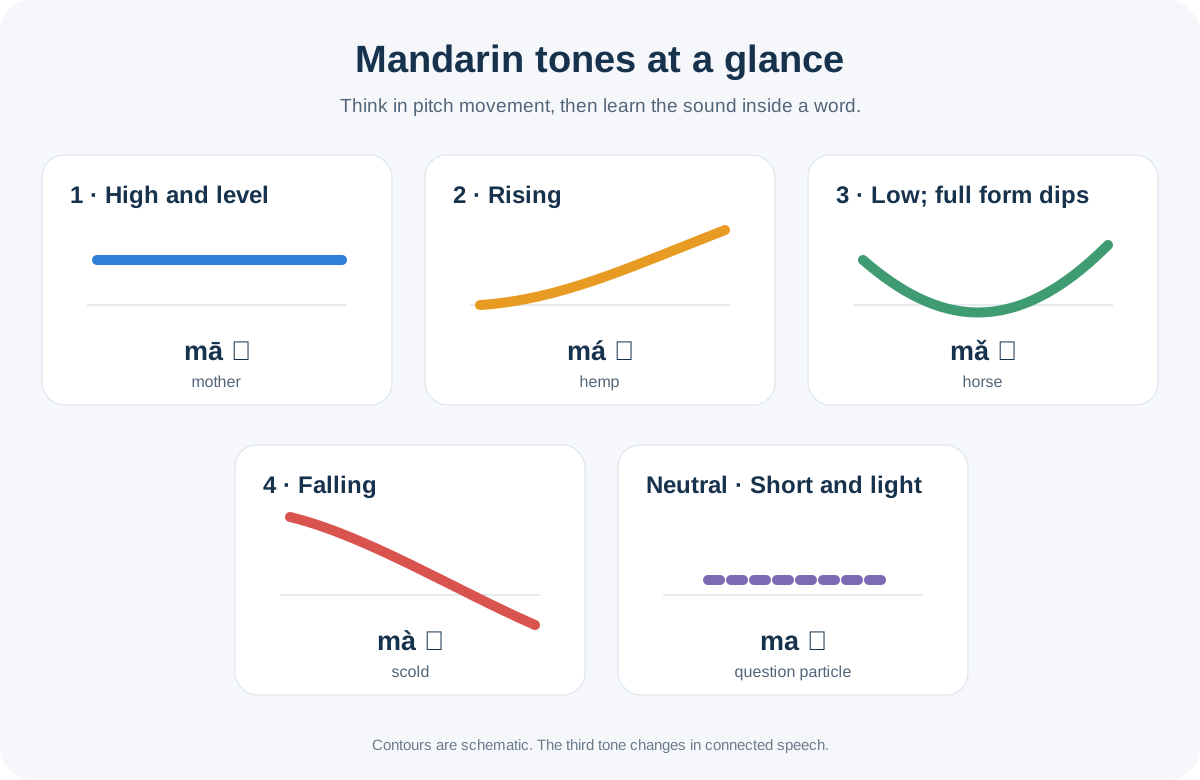
The four tones at a glance
| Tone | Pitch movement | Example | Meaning |
|---|---|---|---|
| 1 | High and level | mā 妈 | mother |
| 2 | Rises | má 麻 | hemp |
| 3 | Low; full form dips and rises | mǎ 马 | horse |
| 4 | Falls sharply | mà 骂 | scold |
| Neutral | Short and unstressed; no fixed contour of its own | ma 吗 | question particle |
The tone marks belong to the whole spoken syllable, not just to a decorative mark over a vowel. Hear the audio for a complete word, then copy its pitch movement. The chart above is a map; your voice does not need to match an absolute musical note.
Why a tone can disappear from memory
A learner may remember the spelling ma and still hesitate over mā, má, mǎ, or mà. That is a recall problem: the written syllable is available, but its spoken form is not attached firmly enough to it yet. A recent learner discussion describes this exact kind of frustration; the practical takeaway is to practise the word’s sound as one unit rather than memorizing a tone number in isolation. See the learner discussion.
A listen–say–recall routine
Use this short loop whenever a new word’s tone will not stick:
- Listen to the complete word. Use a reliable recording that includes the whole word, not only a tone label. Notice the movement of the pitch.
- Say it back in the word or a short phrase. Keep the tone attached to the syllable and its neighbor. Tone-pair practice is useful because words are spoken in sequence; Yoyo Chinese’s tone-pair tool demonstrates that format.
- Hide the Pinyin and recall the sound. Look at the character or meaning and say the word before checking. If the tone is wrong, put that item back into your review set.
- Name the kind of miss. If two recordings sound alike, compare them back-to-back. If you hear the difference but forget it later, test recall from the character. If you know the sound but cannot produce it, record yourself once and compare the contour.
This separates three jobs that are easy to mix together: hearing a contrast, remembering a word, and producing its pitch. Repeating the same drill for all three can hide which part needs attention.
For one short round, use these four recorded words. Listen once, say each whole word, then try to recall its tone from the meaning before checking the Pinyin.
| Meaning prompt | Word to recall |
|---|---|
| clothing | 衣 yī |
| fish | 鱼 yú |
| rain | 雨 yǔ |
| to encounter | 遇 yù |
Listen · four whole words
These synthesized pronunciation previews have not received an independent human pronunciation review.
Read the meaning prompts again, then say the whole word with its tone. Leave a beat after each model so you can copy it before the next one.
Repeat · with a speaking pause
Before the next track, cover the Pinyin column. Listen to the four words in a new order and name each tone aloud; the answer key is below the player.
Recall · identify the tone before checking
Show the recall answers
- Rain: 雨 yǔ — third tone.
- Clothing: 衣 yī — first tone.
- To encounter: 遇 yù — fourth tone.
- Fish: 鱼 yú — second tone.
Check your ear before looking at the marks
Read each pair aloud only after first listening to a recording. Then cover the Pinyin and try to recall both the word and its meaning:
- mā / mà — does the pitch stay high or fall?
- má / mǎ — does the pitch rise or stay low and dip in its full form?
- mǎ / ma — is the syllable stressed with a lexical tone or short and neutral?
If you miss one, do not restart the entire chart. Return to that contrast, listen again, and try recall once more. This is a practice check, not a score or a claim about your overall ability.
Common questions
How do I memorize tones?
A public learner question asks, “How do I memorize tones?”. Treat the spoken word as one item: its syllables, tones, and rhythm together. Listen, say it in a short phrase, then recall it without the Pinyin prompt. Keep a small review set of words whose tones you missed and revisit those before adding more. This is one learner’s question, not a representative survey.
Is the third tone always a dip?
No. The full third-tone contour is commonly drawn as a dip, but connected speech changes what you hear. A third tone before a first, second, or fourth tone is often pronounced as a low half-third tone; a third tone before another third tone changes through tone sandhi. Learn the citation form and the common connected form separately. PolyU explains the half-third tone, and Hacking Chinese covers the third-tone context rule.
Sources and scope
This guide covers Mandarin Chinese. The tone contours and connected-speech note are checked against the Hong Kong Polytechnic University’s phonetics teaching resource. Competitor pages were reviewed for page structure and practice formats; their wording has not been reused. The learner question is paraphrased from a public discussion, not presented as research or as a representative survey.