How to Hear Second and Third Tones in Connected Mandarin
Listen for the low part of a third tone, not just for a rise. In connected Mandarin, a third tone is often low or low-falling when another tone follows; before another third tone, the first third tone commonly changes to a rising contour. A second tone is lexically rising, but its pitch can also shift with context. Compare a known word in a short phrase, check its dictionary tone, then replay the same phrase while tracking only the target syllable.
If a familiar phrase sounds clear but an unfamiliar word does not, the challenge may be connecting the written tone to a word you have not stored as a sound yet. A useful drill keeps the audio short and the comparison specific.
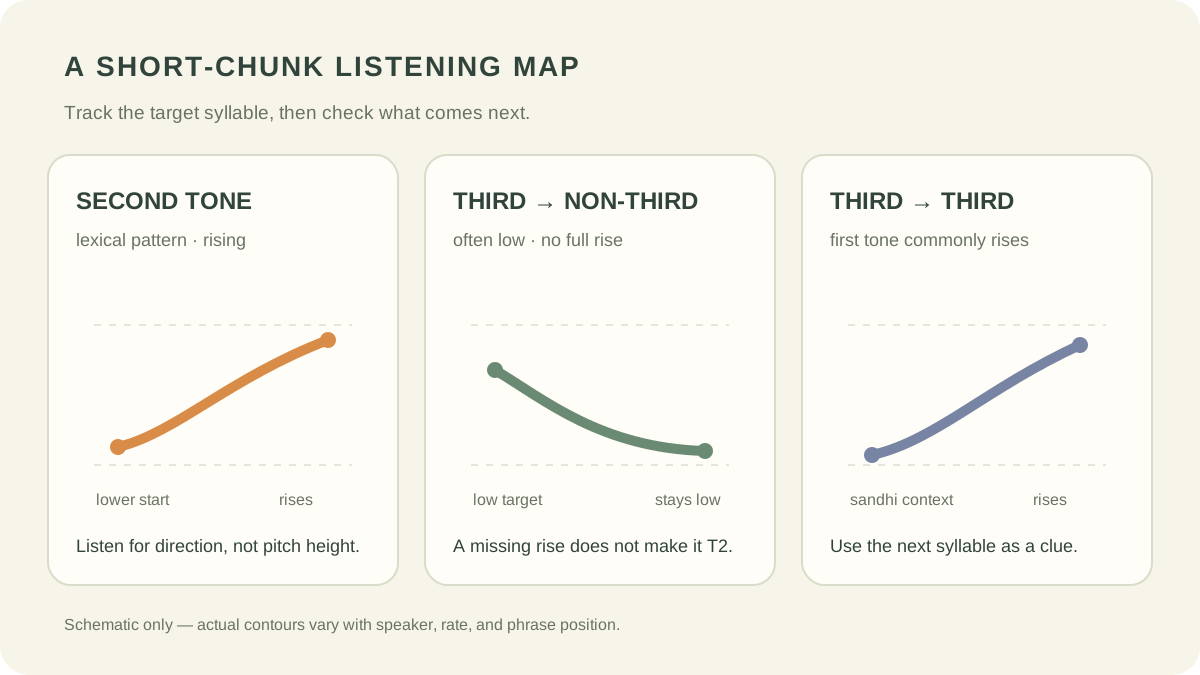
What to listen for
- Second tone: its lexical pattern rises. Listen for a clear upward movement, while allowing its starting and ending pitch to vary with the speaker and neighboring sounds.
- Third tone before a non-third tone: in connected speech, it commonly stays low or falls without the full rise often drawn on beginner charts. This low realization is not automatically a second tone.
- Third tone before another third tone: the first syllable commonly surfaces with a rising, second-tone-like contour, while its lexical identity remains third tone. The pair’s context is what helps you interpret it.
Research on Mandarin tone perception describes both a low-falling third-tone realization before tones 1, 2, 4, or neutral tone and a rising realization before another third tone. That context dependence is one reason a single isolated contour cannot describe every phrase.
A four-pass short-chunk drill
- Choose a familiar recording. Use a word or phrase from a lesson with a clear speaker. Start with two or three syllables, not a whole sentence.
- Write the lexical tones first. Check a reliable dictionary or transcript. Mark the target as second or third tone before you replay it; do not guess the word from a contour alone.
- Listen once for the low target. Replay the phrase at normal speed. Ask whether the target reaches a low point, whether it rises, and what follows it. Notice the contour without demanding an exaggerated dip.
- Compare a matched phrase. Find a familiar second-tone and third-tone example in similar positions. Listen to each twice, then say which difference you actually heard: direction, low target, timing, or neighboring tone.
Keep a tiny listening log
| Clip | Target | One thing to notice |
|---|---|---|
| Short familiar phrase | Dictionary tone | What follows the target? |
| Same phrase, replayed | Low point or rise | Did the contour change with context? |
| Your own attempt | Same target syllable | One feature to adjust next time |
Common listening traps
- Expecting every third tone to dip and rise: the full contour is a useful citation-form model, but it is not required in every connected-speech position.
- Calling every rise a second tone: the first of two adjacent third tones can rise because of tone sandhi. Check the word and its following syllable.
- Comparing different speakers’ absolute pitch: focus on the contour within a speaker’s comfortable range, not on matching another person’s pitch height.
- Practising only isolated syllables: isolated practice can establish a baseline, but short phrases reveal the contextual changes that caused the confusion.
Common question: How can I tell second and third tones apart in unfamiliar words?
One learner asked, “I’m about C1/C2 level in Chinese, but I still have trouble differentiating between second and third tones. Any advice?” Start by checking the word’s dictionary tone instead of inferring it from one pitch trace. Then practise the word in a short phrase: listen for the low target of a third tone, note whether another third tone follows, and compare it with a familiar second-tone recording from the same speaker. When the word is new, save the spelling, meaning, and audio together; return to it in a different phrase later. A rising sound by itself is not enough to relabel a third tone, because third-tone sandhi can produce a rise before another third tone.
Takeaway
Separate a word’s dictionary tone from the way it sounds in a phrase. Check the word, listen to a short chunk, and compare one pitch feature at a time. The low part helps distinguish a third tone when its rise is reduced; the following syllable helps explain when a third tone becomes rising.
Sources
- The Open University, “Beginners’ Chinese: a taster course — 1.3 Tones” — tone marks, canonical contours, and listen-and-repeat examples.
- Chen, Liu & Kager, “Perception of Different Tone Contrasts at Sub-Lexical and Lexical Levels by Dutch Learners of Mandarin Chinese” — discusses context-dependent third-tone realizations and tone perception.
- A learner’s question about distinguishing second and third tones — one learner’s experience, used as a topic prompt rather than evidence about learners generally.